





Crafting Modernity: Design in Latin America, 1940–1980
MoMA, New York, 8 March to 10 November 2024
Curated by Ana Elena Mallet and Amanda Forment
Reviewed by César Sesio for Eye Magazine, Issue 107, Winter 2025
This MoMA exhibition marks the first time a major US museum has comprehensively examined modern design in the region, providing exceptional visibility to women artists and designers. It serves as an introduction to a subject of significant international interest.
During the latter years of the Second World War, Latin American countries experienced economic growth and rapid modernisation as they were far from the international conflict. This period saw contact between Latin America and Europe increase: artists, writers, architects and musicians from Europe who were part of avant-garde movements visited countries such as Argentina, Brazil, Chile, Colombia, Mexico and Venezuela, exchanging ideas with local artists. Meanwhile, Latin-American practitioners and educators travelled to Europe and North America in search of enriching experiences in education institutions and design studios. This dialogue gave rise to new hybrids that combined international and regional traditions and ideas. It also started the gradual professionalisation of design, which had not existed as a formal discipline in Latin America before the 1950s.
During the 1940s, as a consequence of the war in Europe, countries in Latin America began producing goods domestically to replace traditionally imported items. The abundance of materials led to the rapid growth of national industries, creating employment opportunities for local designers. However, in order to understand the development of Modernism in Latin America, we need to consider the tragic interventions of democratic states by de facto governments. These interventions were motivated by concerns about the spread of left-leaning ideologies and the interests of investors from developed economies. In the late 1970s, a series of economic crises unsurprisingly erupted across the region, signalling the end of the developmental model in Latin America. This period was characterised by the states’ involvement in promoting modernisation and nurturing internal markets.
Nevertheless, Latin America was not a homogeneous territory. Designers across the region proposed diverse and sometimes conflicting interpretations of Modernism and its relation to politics. Despite the differences, both sides agreed with the Modernist belief that arts and design, when combined, could transform humanity through the invention of new forms and experiences.
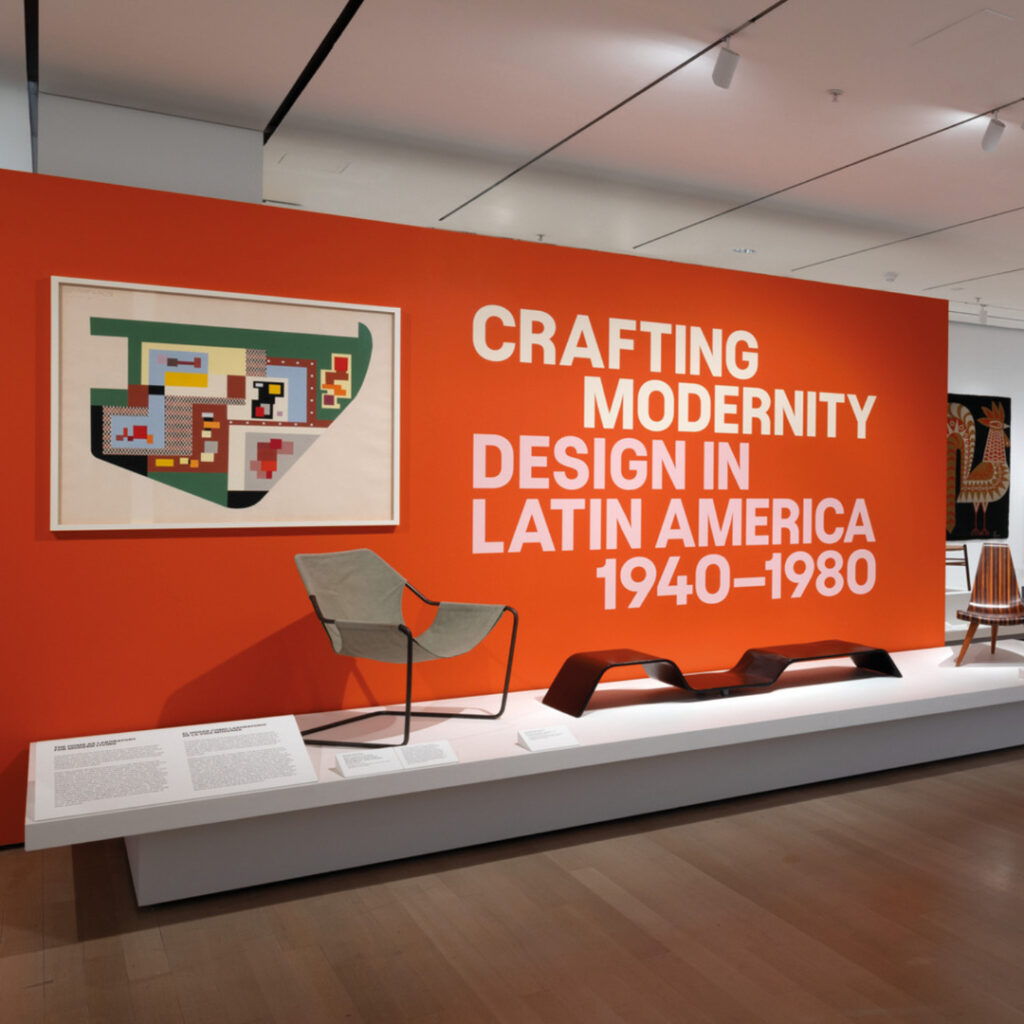
These designers collaborated on projects embracing the concept of the total work of art and collectively envisioned ways to improve modern life. The exhibition features more than 100 artefacts, including housing, furniture, graphic design, textiles and ceramics – from the MoMA collection, as well as public and private collections in the United States, Latin America and Europe. It is in everyday life where the exhibition finds its most solid grounding: the upper middle-class home and its appliances. The chair is a common element representing various countries and cultures.
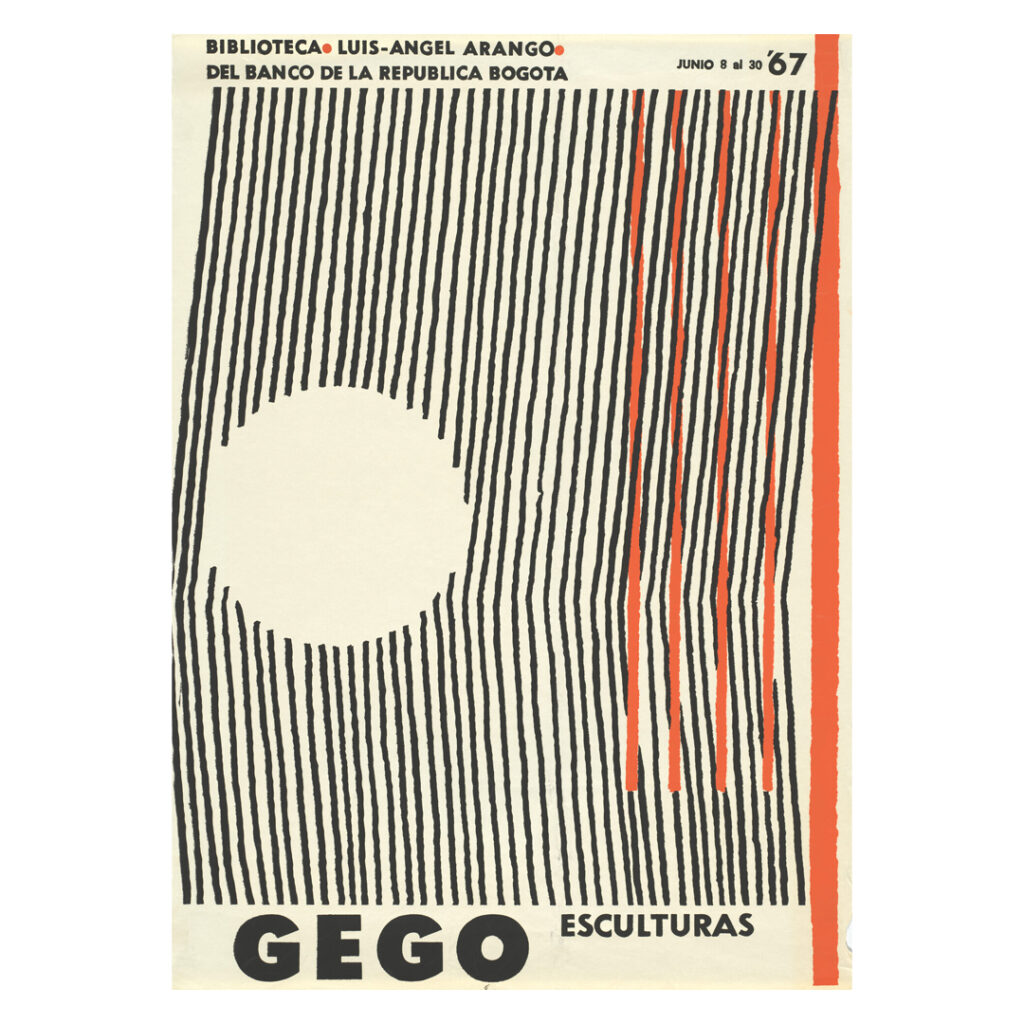
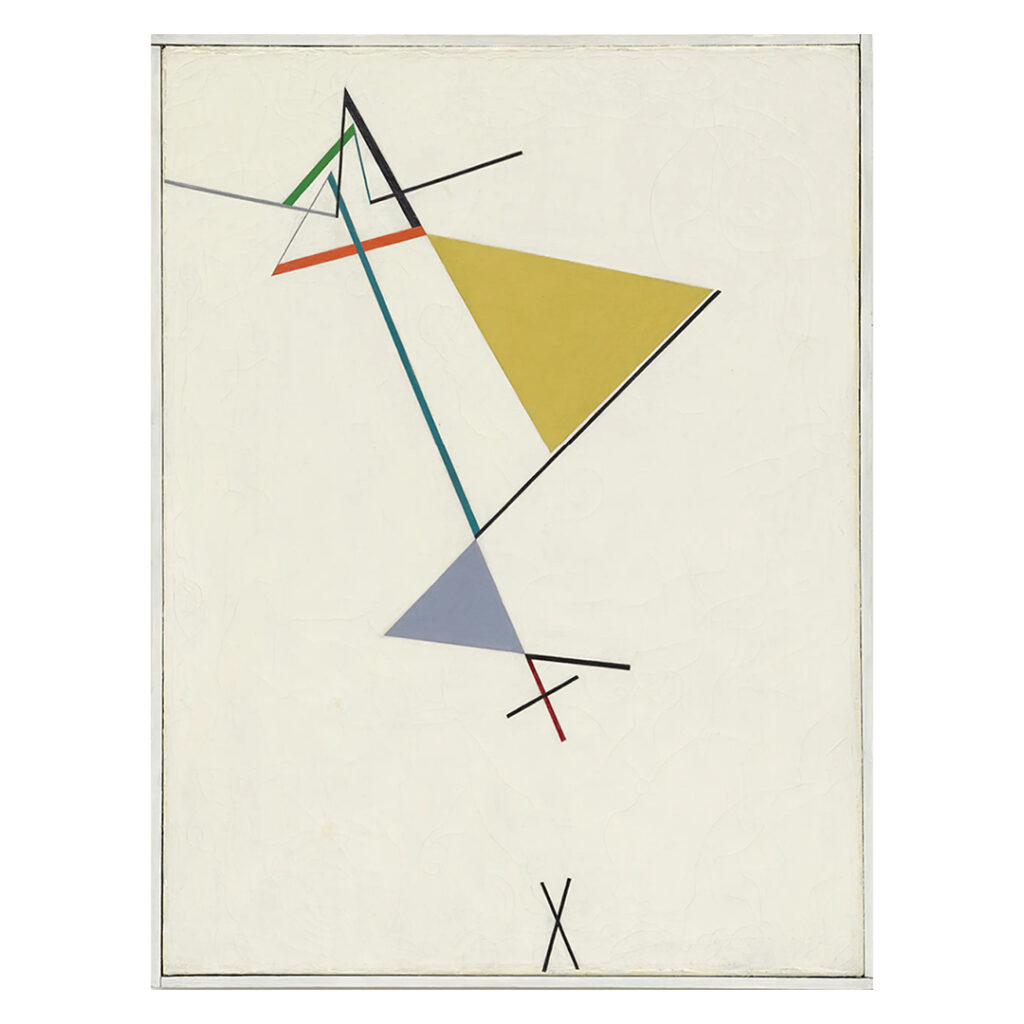
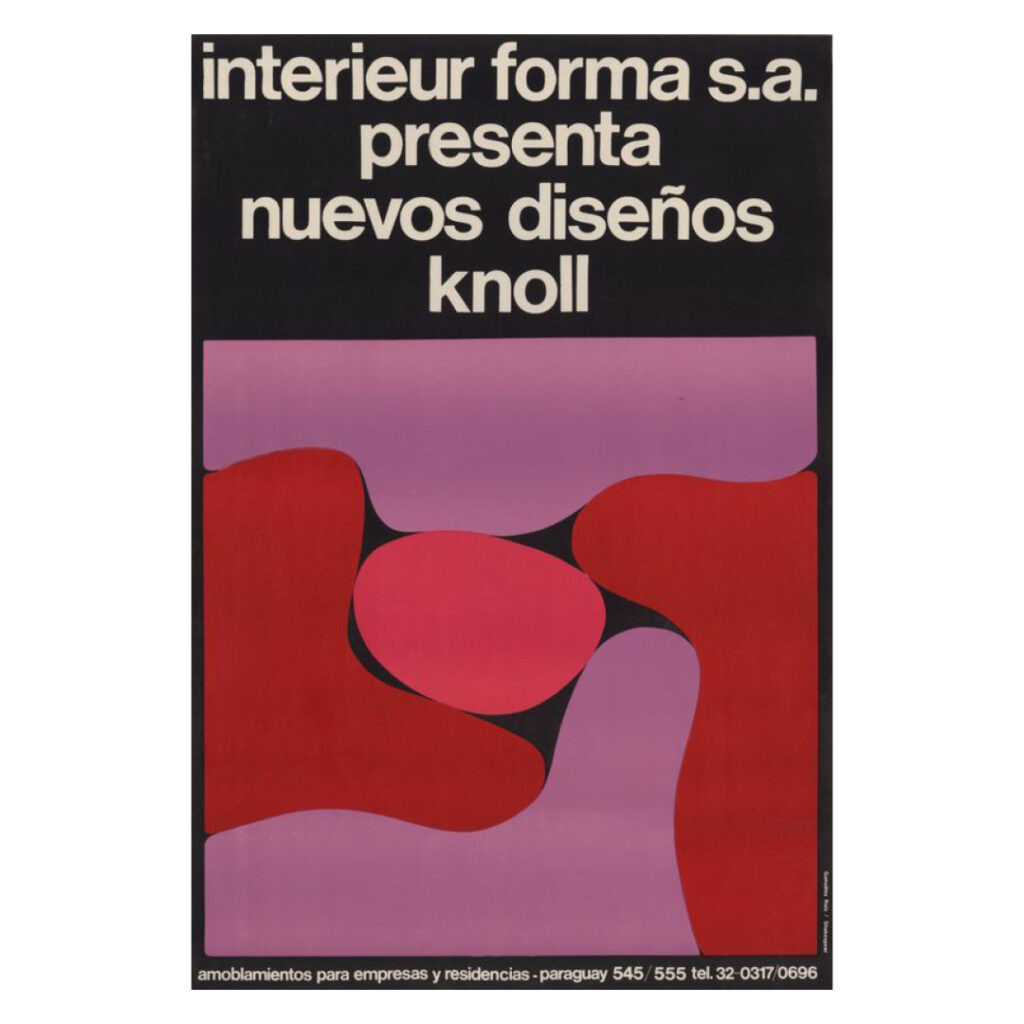
In the graphic design and visual arts selection there is an interesting dialogue, using geometric forms, between other objects and graphic pieces, and between graphic pieces produced by different designers for different contexts and clients. A carpet designed by German artist Gego (Gertrud Goldschmidt) provides a clue to the source of inspiration for posters designed by Lithuanian Gerd Leufert for two of Gego’s exhibitions; while Development of a Triangle (1949), an oil on canvas by a young Tomás Maldonado, the Argentine future teacher and rector at the Ulm School of Design in Germany, speaks directly to a poster promoting The Third Biennial at the Museum of Modern Art, São Paulo by Brazilian designer Alexandre Wollner. Moving from the 1950s to the 1960s there is the inventive Olivetti poster convening typography and an op-art infused treatment, designed by Juan Carlos Distéfano, Rubén Fontana and Carlos Soler from the first Department of Graphic Design at the then recently created Instituto Torcuato Di Tella, Buenos Aires, Argentina. The organic shapes of Chilean Roberto Matta’s Malitte Lounge Furniture, a versatile set of seats that when stacked serves as a room divider, are literally taken into a bidimensional plane for a promotional poster created by Argentine designers Guillermo González Ruiz and Ronald Shakespear.
Although it is not explicitly stated why the 1980s is the chosen point at which to end the exhibition, it might signal that, by then, the economic and political landscape had changed enough to signify the end of the active Modernist ideal. A new wave of neo-liberal policies came in during the late 1980s that altered the state’s role in promoting the Modernist design project – and ending the show’s span here also establishes significant historical distance to allow for an objective perspective of Modernism and its developments and repercussions.
The exhibition ends with a diagram showing protagonists from different countries interconnected by lines, representing their various interactions across the region. These powerful stories are not often shared; stories of educators and practitioners who paved the way for new generations of designers up to the present. The visitor is left to rethink how to understand and value design, is invited to look beyond the final products and to leave behind Eurocentric paradigms.